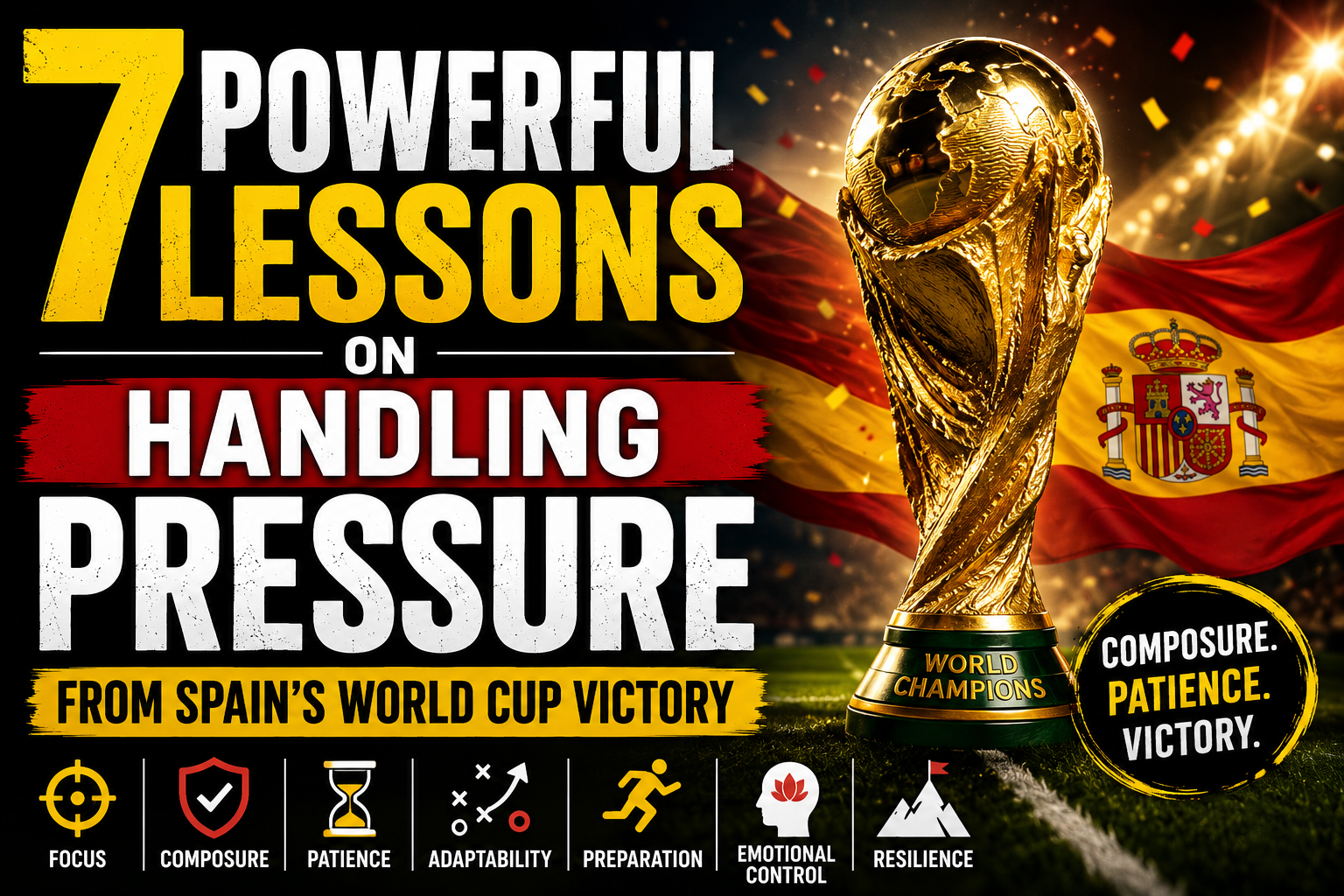
7 Powerful Lessons on Handling Pressure from Spain’s World Cup Victory (2026 Guide)
Pressure is something everyone experiences. Whether you’re preparing for an important exam, delivering a presentation at work, launching a business, or making a life-changing decision, the ability to remain calm often determines the outcome more than talent alone.
One of the greatest modern examples of handling pressure came during Spain’s dramatic FIFA World Cup victory. The final wasn’t simply a football match—it became a masterclass in patience, resilience, emotional control, and trusting the process.
For nearly the entire match, neither team could find a breakthrough. Every minute increased the tension. Millions of fans watched every pass, every mistake, and every opportunity. Yet Spain refused to panic. Instead, they stayed disciplined, trusted their system, and eventually found the winning moment when it mattered most.
The lessons from that performance extend far beyond football. They apply to business leaders facing uncertainty, students preparing for exams, entrepreneurs building companies, athletes competing at the highest level, and anyone trying to overcome life’s challenges.
Here are seven powerful lessons on handling pressure we can all learn from Spain’s World Cup triumph.
1. Handling Pressure Starts with Preparation, Not Confidence
This principle applies everywhere.
When people prepare thoroughly, their minds have less room for panic.
Think about:
- A student who practices hundreds of exam questions.
- A speaker who rehearses a presentation repeatedly.
- A surgeon who has performed the same procedure countless times.
- An entrepreneur who has studied every possible business scenario.
Preparation reduces uncertainty, and reducing uncertainty makes pressure easier to manage.
Practical Tip
Instead of asking:
“How do I become more confident?”
Ask:
“How can I become better prepared?”
Confidence naturally grows from consistent preparation.

2. Handling Pressure Requires Patience When Results Don’t Come Immediately
People quit because:
- The business isn’t profitable after six months.
- The gym doesn’t produce visible results in four weeks.
- The YouTube channel grows slowly.
- The promotion doesn’t come immediately.
Often, nothing is wrong.
You’re simply in the difficult middle phase where progress is happening beneath the surface.
Success frequently belongs to those who continue executing the right process long after others become impatient.

3. Handling Pressure Means Adapting Without Losing Your Standards
Every high-pressure situation changes unexpectedly.
Plans fail.
Unexpected obstacles appear.
People make mistakes.
Champions aren’t those who avoid problems—they’re the ones who adjust without lowering their standards.
During the World Cup final, Spain continuously adapted to changing circumstances while maintaining discipline and tactical organization.
That’s emotional flexibility.
The same principle applies in everyday life.
Perhaps:
- Your project suddenly loses funding.
- Your team member resigns.
- Your client changes requirements.
- Your travel plans collapse.
The situation changes.
Your commitment to excellence doesn’t have to.
Successful people ask:
“Given these new conditions, what’s the best possible move now?”
They don’t waste energy wishing reality were different.
4. Handling Pressure Is Easier When Every Team Member Is Ready
Championships aren’t won by stars alone.
Spain’s winning moment highlighted the importance of squad depth.
Players coming off the bench changed the game because they stayed mentally prepared despite not starting.
That’s an important life lesson.
Sometimes you’re not the first choice.
Sometimes your opportunity arrives unexpectedly.
Sometimes your biggest chance appears after months—or even years—of waiting.
Preparation during quiet seasons determines performance during important moments.
Whether you’re:
- Waiting for a promotion
- Building your skills
- Looking for a new job
- Growing a business
- Developing a personal brand
Stay ready.
Opportunity rarely announces itself in advance.
As the saying goes:
“Luck is when preparation meets opportunity.”
5. Handling Pressure Requires Emotional Control, Not Emotional Suppression
Pressure creates powerful emotions.
Fear.
Excitement.
Frustration.
Self-doubt.
These emotions aren’t the enemy.
Allowing them to control your decisions is.
Spain showed remarkable emotional discipline throughout the final.
They didn’t celebrate too early.
They didn’t lose composure after missed opportunities.
They didn’t become reckless because time was running out.
Emotional regulation means acknowledging your feelings while continuing to act wisely.
Research in sports psychology consistently shows that elite performers aren’t emotionless—they simply recover from emotional spikes much faster than average performers.
Healthy Ways to Regulate Emotions
- Practice slow, controlled breathing.
- Focus only on the next action.
- Replace catastrophic thoughts with realistic ones.
- Maintain positive self-talk.
- Accept mistakes quickly and move forward.
Emotional control is a trainable skill.
The more you practice it, the stronger it becomes.
6. Handling Pressure Becomes Easier Through Consistent Daily Habits
People often admire championship performances without appreciating the years of preparation behind them.
Spain’s success wasn’t created in one match.
It was built through:
- Daily training
- Tactical preparation
- Team chemistry
- Consistency
- Discipline
- Trust
The same pattern appears in every area of life.
High performers rely less on motivation and more on habits.
Your ability to stay calm during major challenges reflects what you’ve repeatedly practiced during ordinary days.
Small habits compound.
Reading daily improves decision-making.
Regular exercise builds physical resilience.
Meditation strengthens focus.
Consistent sleep improves emotional regulation.
Journaling enhances self-awareness.
When pressure arrives, your habits become your foundation.
7. Handling Pressure Means Focusing on the Next Moment, Not the Final Outcome
One reason pressure feels overwhelming is that people mentally jump to the end.
“What if I fail?”
“What if everyone judges me?”
“What if this ruins everything?”
Those thoughts distract from the only thing you can actually control—the next action.
Spain couldn’t control:
- Public expectations
- Media headlines
- Crowd reactions
- The referee
- The opponent
They could control:
- The next pass.
- The next defensive action.
- The next opportunity.
This mindset is incredibly powerful.
Whether you’re taking an exam, interviewing for your dream job, or starting a company, focusing on the immediate task reduces anxiety and improves performance.
Instead of obsessing over the destination, concentrate on taking one excellent step after another.
That’s how difficult goals become achievable.
Why Spain’s World Cup Victory Resonated Beyond Football
Great sporting moments inspire millions because they reflect universal human experiences.
Pressure.
Failure.
Persistence.
Hope.
Resilience.
Spain’s victory wasn’t memorable simply because they lifted a trophy.
It demonstrated that calm thinking can overcome chaos.
That patience can defeat panic.
That preparation beats talent when talent loses discipline.
These lessons remain valuable whether you’re leading a business meeting or competing on the world’s biggest sporting stage.
Practical Ways to Improve Your Ability to Handle Pressure
If you want to perform better under stress, begin incorporating these habits into your daily routine:
- Prepare more than you think is necessary.
- Focus on the process instead of immediate results.
- Control what you can influence.
- Accept uncertainty without resisting it.
- Build consistent daily habits.
- Practice emotional regulation through breathing and mindfulness.
- Learn from setbacks rather than fearing them.
- Stay ready for opportunities before they arrive.
- Break large challenges into small, manageable actions.
- Remember that pressure is often a sign you’re pursuing something meaningful.
Over time, these practices build resilience that lasts far beyond a single moment of success.
Final Thoughts
Spain’s World Cup victory serves as a powerful reminder that handling pressure is not about eliminating fear—it’s about responding wisely despite it.
The players faced extraordinary expectations, relentless tension, and the weight of an entire nation’s hopes. Yet they remained patient, trusted their preparation, adapted to changing circumstances, and seized their opportunity when it finally arrived.
Life rarely places us inside a World Cup final, but it regularly presents moments that feel just as significant on a personal level. A career-changing interview, an important conversation, a financial decision, or a major life transition can all test our ability to stay composed.
The encouraging truth is that resilience isn’t something you’re born with. It’s developed through preparation, disciplined habits, emotional regulation, and the willingness to keep moving forward when success isn’t immediate.
Pressure is inevitable. Panic is optional. And as Spain demonstrated, those who stay composed when it matters most are often the ones who create history.
If pressure tends to spiral into anxious, repetitive thinking for you, these strategies for overthinking pair well with the composure-building ideas here. And if sustained effort without visible progress has you questioning whether to keep going, our guide on signs of burnout and how to recover covers the related territory of pushing through long, demanding stretches sustainably.
A Note on Tracking Your Own Progress
Some readers find it useful to keep a simple log of what dysregulates them and what actually helps — over time, patterns emerge that generic advice can’t capture. If you’d like a private space to track this (a journal, a habit log, or even a personal wellness blog), setting one up is simpler than it sounds. We use Hostinger for hosting sites like this one — it’s affordable, quick to set up, and a solid starting point if you ever want a dedicated space of your own. This post contains an affiliate link. If you purchase through it, we may earn a small commission at no extra cost to you.
FAQ
Can mental toughness actually be trained, or is it innate? It can be trained. While some people may have a natural head start, composure under pressure is built the same way physical skills are — through repeated exposure to challenging situations and deliberate practice, not through fixed personality traits.
What’s the difference between mental toughness and just suppressing emotion? Mental toughness isn’t about not feeling pressure or anxiety — it’s about being able to function effectively despite it. Suppressing emotion entirely tends to backfire under sustained stress; genuine composure includes acknowledging the pressure while still executing.
How does team psychology differ from individual mental toughness? Team psychology adds a layer of shared trust and coordinated composure — each person’s ability to stay steady is influenced by, and influences, everyone else’s. That’s part of why cohesive teams often outperform collections of individually talented but less connected players under pressure.
This article draws on the 2026 FIFA World Cup final (Spain vs. Argentina, July 19, 2026) as an illustrative example and is written for general educational purposes about performance psychology.